

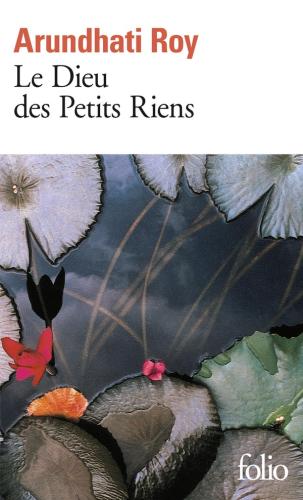
Le dieu des petits riens de Arundhati Roy
Folio (éditeur)
Claude Demanuelli (traduction)
Quatrième de couverture : Rahel et Estha Kochamma, deux jumeaux de huit ans, vivent en Inde, entourés de leur grand-mère, Mammachi, qui fabrique des confitures trop sucrées, de l'oncle Chacko, un coureur de jupons invétéré, esprit romantique converti au marxisme pour les besoins de son portefeuille, de la grand-tante Baby Kochamma, qui nourrit un amour mystique pour un prêtre irlandais, et de leur mère Ammu, désertée par son mari, qui aime secrètement Velutha, un Intouchable. Un drame va ébranler leur existence et les séparer. Comment réagir quand, à huit ans, on vous somme de savoir «qui aimer, comment et jusqu'où» ? Comment survivre quand, après un événement affreux dont on a été témoin, on vous demande de trahir la vérité pour l'amour d'une mère ? Un récit envoûtant, plein d'humour et d'émotion, servi par une écriture neuve et poétique, qui recrée le monde de l'enfance - celui de l'imaginaire et de la liberté.

Premier (et rare) roman de Arundhati Roy, écrivaine indienne, qui lui a valu le Booker Prize en 1997 et a connu un succès mondial dès sa parution. Arundhati Roy est une écrivaine et aussi une militante engagée dans la défense de l’environnement, des droits humains (droit foncier des autochtones, droit des femmes) et contre le fondamentalisme hindou. Elle a publié de nombreux essais et analyses politiques et un seul autre roman, The Ministry of Utmost Happines ( Le ministère du Bonheur suprême). «?Le Dieu des Petits Riens?» est un livre bouleversant, un livre d’émotions et de sensations. C’est l’histoire d’un drame familial?qui se déroule au sein d’une famille chrétienne et anglophile aisée vivant dans l'état du Kérala (côte ouest dans le sud de l'Inde). Le fil conducteur, ce sont deux enfants, deux jumeaux «?dizygotes?», Rahel, la fille et Estha, le garçon dont la vie bascule dans le drame alors qu’ils ont 7 ans, leur mère Ammu, divorcée et rebelle qui brave les conventions, l’intouchable Vélutha avec qui les enfants sont unis par une profonde amitié. Il y a aussi la grand-mère autoritaire et aveugle, la grand-tante perfide et sa fidèle domestique, prisonnières des conventions et de leur désir d'imiter le mode de vie des anglais. Les évènements vont s'enclencher pour précipiter ces destins vers la mort, la violence, le rejet, le mensonge, la folie. Le récit n’est pas linéaire et il nécessite un peu de concentration. L’intrigue est un puzzle à reconstituer avec nombreux retours en arrière et bonds en avant. Au début l’absence de repères temporels, les noms indiens, la structure complexe de la famille rendent la lecture un peu complexe mais très vite on est happé par l’intrigue et par l’écriture. L’écriture est magnifique, singulière, poétique. Splendeur et pittoresque de la langue inventée par les enfants?: Répétitions, images, émotions "L'homme Orangeade-citronade, Un-fini bonheur, le papillon aux pattes gelées sur le cœur de Rahel, Pas de Statue l'Egale, les sept vergetures d'Ammu…" Livre de sensations également?: la pluie qui s'abat sur le jardin, la chaleur moite de la mousson, les couleurs des saris, la magie des cours d’eau…. Ce livre est également un portrait poignant qui aborde la dure réalité de l’Inde, dénonçant le système profondément ignoble des castes, dénonçant également la condition faite aux femmes, le racisme post-colonial, la violence au sein de la famille, le viol, la pédophilie, la corruption. Ce sont ces violences du monde adulte sublimées par le regard d’enfants posé sur le monde qui vont provoquer le drame et avoir raison de l’innocence de l’enfance. Si ce n’est le style déroutant du début, ce livre est un coup de cœur quasi unanime.

Arundhati Roy is a writer and also an activist who warns against the dangers of Hindu fundamentalism and is committed to the protection of the environment and the defense of human rights – including women’s rights and land rights of indigenous peoples. She has published numerous essays and political analyses and only one other novel, The Ministry of Utmost Happiness. The God of Small Things is a powerful novel, a novel of emotions and sensations. It is the story of a well-to-do, anglophile Christian family living in the State of Kerala, on the western coast of southern India. The common thread which links characters and events are two children: Rahel, the girl and Estha, the boy, fraternal twins whose lives will take a dramatic turn when they’re seven; their mother Ammu, a divorced and rebellious woman who defies convention; the untouchable Velutha, whose friendship has created a profound connection with the twins. There’s also the authoritarian and blind grandmother, the treacherous great aunt and her loyal servant, both prisoners of convention who emulate the English and long for their way of life. As the events gain momentum, they trigger the tragic events that will shape their destinies, leading to death, violence, rejection, lies, and madness. The narration is not linear and some concentration is needed on the reader’s part. The plot is a kind of puzzle to be unraveled as it repeatedly cuts back and forth between the present and the past. In the beginning, especially, where there are no temporal clues to guide him along, the Indian names, and the complex structure of the family do make the reading a bit challenging. But the reader is very quickly drawn into the story and is amazed by the uniqueness of the prose. The quality of the writing is magnificent, rare, poetic; we are struck by the beauty and vividness of the language invented by the children, with its repetitions, images and emotions: The OrangedrinkLemondrinkMan?, Infinnate Joy, no Locusts Stand I, a cold moth, with its icy legs on Rahel’s careless heart, Ammu’s seven silver stretchmarks It is a book of sensations as well: the rain falling in swirls upon the garden, the sticky heat of the monsoon, the colors of the saris, the magic of the waterways. This book also offers a poignant portrayal of the harsh reality of India, criticizing the profoundly despicable caste system, and is equally unsparing in denouncing the place of women in society, post-colonial racism, violence within the family circle, rape, pedophilia, corruption. It is these adult vices sublimated through the eyes of children as they contemplate the world around them which will trigger the tragedy and put a definitive end to the innocence of childhood. The disconcerting style of the opening passages notwithstanding, praise for the book was, in our group, virtually unanimous.