

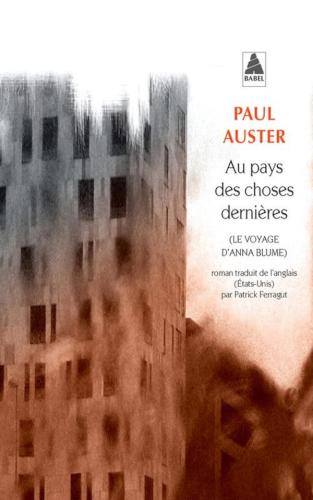
Au pays des choses dernières de Paul Auster
Actes Sud (éditeur)
Patrick Ferragut (traduction)
Quatrième de couverture : De ce "pays des choses dernières" où elle tente de survivre au froid et au désespoir, Anna Blume - venue chercher son frère disparu - écrit une longue lettre dont on ne sait si elle trouvera jamais son destinataire. Un roman sur le rapport au monde et au langage.

Au pays des choses dernières (initialement intitulé Le voyage d’Anna Blume) de Paul Auster. Traduction. Patrick Ferragut Très grand roman dystopique, véritable choc littéraire pour la plupart d’entre nous. Le personnage principal Anna écrit à un ami resté au pays d’origine et décrit la vie dans cette ville « des choses dernières » où elle est venue à la recherche de son frère. Aucune indication de lieu ni de temporalité pour cette ville de terreur et de destruction, coupée du monde extérieur et dont il semble impossible de sortir. Ville peuplée de sans-abris réduits aux stratégies de survie les plus odieuses. Ville divisée en sectes (les Nettoyeurs, les Spectres, les Coureurs, les Sauteurs, les Charognards…) qui gravitent autour de la récupération des déchets et de la mort. « Il y a quand même ceux d’entre nous qui réussissent à vivre. Car la mort aussi est devenue source de vie ». Dans cette cité de terreur, Anna va malgré tout survivre et ce, grâce à l’amitié d’Isabelle, à l’amour de Sam et de Victoria, grâce à la littérature « Le livre de Sam est devenu la chose la plus importante de ma vie. J’ai pris conscience que tant que nous n’arrêtions pas d’y travailler, la notion d’un avenir possible continuerait à exister pour nous ». Grâce aussi à un engagement envers les plus défavorisés. Cependant, au fur à mesure que la situation empire, ce ne sont plus ces « aides » qui permettent de survivre mais leur charge symbolique. Concernant les livres : « Les livres nous ont servi à nous chauffer pendant cet hiver…je sais que c’est épouvantable mais nous n’avions pas vraiment le choix…L’ironie de la chose ne m’échappe pas- passer tous ces mois à travailler à un livre en même temps que nous brûlions des centaines d’autres ouvrages pour nous tenir chaud ». De même concernant l’aide humanitaire : « il y avait trop de gens à aider et pas assez de gens pour les aider. On pouvait travailler tant qu’on voulait, il n’y avait aucune possibilité de ne pas échouer…. Sauf si on acceptait la totale futilité de ce travail » Sorti en 1987, ce roman rappelle de grandes œuvres dystopiques tels le film « Soleil Vert » (1973) tiré du livre de Harry Harrisson, le roman « La servante écarlate » de Margaret Atwood ( 1985), le roman « 1984 » de Georges Orwell (1949). Il est pétri de références littéraires : T. Beckett, F. Kafka mais aussi N. Hawthorne (Mosses From an Old Manse, 1848). Ce livre d’une perfection formelle remarquable est peut-être le plus beau livre de P. Auster. Il a cependant rebuté certaines qui ont en particulier noté un manque de cohérence du propos révélé par le fait que la lettre d’Anna nous arrive alors qu’une idée maitresse du roman est l’impossibilité de sortir de cette ville.

In the Country of Last Things by Paul Auster An extraordinary dystopian novel and startling literary discovery for most of us . The main character, Anna, is writing a letter to a friend who has remained in their country of origin; she describes the life in the “city of last things” where she has come searching for her missing brother. There is no indication of time or place in this city of terror and destruction, cut off from the outside world with no escape possible. It is a city inhabited by the homeless who resort to the most vile strategies in order to survive. A city divided among sects - the Cleaners, the Specters, the Runners. The Leapers, the Scavengers - all of whom revolve around death and the recovery of waste. Still, there are those of us who manage to live. For death too, has become a source of life. In this terror-ridden city Anna will nevertheless manage to survive, thanks to her friendship with Isabel, to the love of Sam and Victoria, and to literature (...) Sam’s book became the most important thing in my life. As long as we kept working on it, I realized, the notion of a possible future would continue to exist for us. Thanks also to her committment toward the under- privileged. However, as the situation worsens, it is no longer these “aids” that make it possible to survive, but rather the symbolic force they exert: concerning books: The books were how we kept warm during the winter. (...) I know it sounds like a terrible thing to have done, but we really didn’t have much choice. (...) The irony does not escape me, of course - to have spent all those months working on a book and at the same time to have burned hundreds of other books to keep ourselves warm. Similarly, concerning humanitarian aid: There were too many people to be helped and not enough people to help them. (...) No matter how hard you worked there was no chance you were not going to fail. (...) Unless you were willing to accept the utter futility of the job (...). Published in 1987, this novel is reminiscent of other noteworthy dystopian works such as the film “Soylent Green” [1973] based on the book by Harry Harrisson, Margaret Atwood’s novel “The Handmaiden’s Tale” [1985] , and “1984” by George Orwell [1949]. and is filled with literary references: Beckett, Kafka and Hawthorne .(”Mosses From an Old Manse” [1848]), among others. Its structure is remarkable, to the point of near perfection. The book is perhaps Auster’s best Yet it did not appeal to all of us who who pointed out the novel’s lack of coherence in that Anna’s letter did, in the end, reach its destination while the the underlying idea that is pervasive throughout the novel is the impossiblity of escape from this city.